The Office of the Commissioner for Federal Judicial Affairs Canada’s 2025-26 Departmental results report
On this page:
- At a glance
- From the Commissioner
- Results: what we achieved
- Spending and human resources
- Supplementary information tables
- Federal tax expenditures
- Corporate information
- Definitions
Copyright Information
© His Majesty the King in Right of Canada, as represented by the Minister of Justice and Attorney General of Canada, 2026
Catalogue Number: J41-5E-PDF
ISSN: 2561-2778
Aussi disponible en français sous le titre : Rapport sur les résultats ministériels 2025-2026
At a glance
This departmental results report details the Office of the Commissioner for Federal Judicial Affairs Canada’s actual accomplishments against the plans, priorities and expected results outlined in its 2025-26 Departmental Plan.
These results align with the priorities outlined in the May 21, 2025, mandate letter from the Prime Minister, as well as with the Office of the Commissioner for Federal Judicial Affairs Canada’s vision, mission, raison d’être and operating context.
Key priorities
The Office of the Commissioner for Federal Judicial Affairs Canada identified the following key priorities for 2025-26:
- Provide ongoing support to federally appointed judges through digital modernization, judicial education, and improved well-being initiatives.
- Enhance departmental effectiveness by implementing solutions that modernize information technology tools and services.
- Continued administration of the judicial appointments process, including further digitization of the application process for enhanced efficiency.
- Strengthen international judicial cooperation through exchanges, delegations, and programs like the Technical Assistance Partnership program.
Highlights
In 2025-26, the Office of the Commissioner for Federal Judicial Affairs Canada (FJA) advanced several modernization initiatives to improve the delivery of services to federally appointed judges and support more efficient operations. The judicial appointments process was modernized through the introduction of electronic application submissions, reducing paper-based processes for candidates. In addition, FJA made significant progress towards transitioning its legacy Regional Pay System (RPS) pension platform for retired judges and their survivors to the modernized platform PENFAX. In keeping with its commitment to remain current with its digital stance, through out the course of the year, FJA undertook the work necessary to transition to full cloud technology, rolling out the M365 tools across employee devices, strengthened its digital services, including the security and reliability of its in-house JUDICLOUD platform, and leveraged a variety of digital tools and resources in support of its Judges’ Language Training program. These initiatives support FJA’s efforts to provide secure, reliable and efficient services to the judiciary.
- Total actual spending (including internal services): $840,719,326
- Total full-time equivalent staff (including internal services): 67
For detailed information on FJA’s total spending and human resources, read the Spending and human resources section of this report.
Summary of results
The following provides a summary of the results the department achieved in 2025-26 under its “core responsibility” (its main area of activity).
Core responsibility: Support to federally appointed judges
Actual spending: $839,021,610
Actual human resources: 56.5
In 2025-26, FJA provided services and support to federally appointed judges across Canada, contributing to the independence and effective functioning of the federal judiciary. FJA administered the judicial appointments process, provided administrative and financial services to judges, and supported access to judicial education and language training. FJA also advanced modernization initiatives to improve the delivery of services, including the digitization of the judicial appointments process and improvements to digital and pension services.
The Canadian Judicial Council continued its work related to judicial conduct and education, while Federal Courts Reports continued to provide Canadians with access to important federal court decisions in both official languages. Internationally, FJA strengthened judicial cooperation through exchanges and technical assistance programs that supported judicial independence, access to justice and the rule of law.
Together, these activities demonstrate FJA’s role in supporting an independent, effective and accessible federal judiciary and maintaining Canadians’ confidence in the justice system.
For more information on FJA’s activities related to Support to federally appointed judges read the “Results: What we achieved” section of this report.
From the Commissioner

Marc A. Giroux
Commissioner for Federal Judicial Affairs
I am pleased to submit the Departmental Results Report for the Office of the Commissioner for Federal Judicial Affairs Canada for the fiscal year ending March 31, 2026. This report provides Parliamentarians and Canadians with information regarding what we accomplished and achieved over the past year.
The 2025-26 fiscal year was marked by continued efforts to modernize our services and strengthen the support provided to federally appointed judges. My Office advanced a number of initiatives to improve the way we deliver services, including the digitization of the judicial appointments application process, the stabilization of JUDICLOUD, and progress toward a new pension system for retired judges and their survivors.
The Judicial Appointments Secretariat continued to support the work of Judicial Advisory Committees across Canada, processing applications and supporting judicial appointments and elevations. The transition to electronic applications reduced paper-based submissions and made the application process more accessible and efficient.
My Office also continued to provide support in the area of corporate services, including IT and technological support, to the Canadian Judicial Council in its work related to judicial conduct and education. We also continued to refine and improve the judges’ language training program so as to provide judges with the best adaptive learning, in conjunction with delivering other tailored services to support their professional needs. Internationally, my Office strengthened judicial cooperation through the Technical Assistance Partnership program and the Equal Justice for All in Mongolia project, supporting judicial independence, access to justice and the rule of law.
I extend my appreciation to all members of our personnel for their continued dedication, professionalism and commitment to supporting the federal judiciary.
Results: what we achieved
Core responsibility and internal services
Core responsibility: Support to federally appointed judges
In this section
- Description
- Quality of life impacts
- Progress on results
- Details on results
- Resources required to achieve results
- Related government priorities
- Program inventory
Description
To provide services and support to the federally appointed judges in a manner which contributes to the independence of the judiciary and the confidence of Canadians in our judicial system.
Quality of life impacts
Domain: Good Governance
Indicators: Confidence in institutions, representation in senior leadership positions, access to fair and equal justice
Progress on results
This section details the department’s performance against its targets for each departmental result under Core responsibility: Support to federally appointed judges.
Table 1 shows the target, the date to achieve the target and the actual result for each indicator under Federally appointed judges are provided with centralized services in a timely and effective manner in the last three fiscal years.
Table 1: Federally appointed judges are provided with centralized services in a timely and effective manner
|
Departmental result indicator |
Target |
Date to achieve target |
Actual result |
|
% of judges’ allowances processed within the 10-day service standard |
90% |
March 2026 |
2023-24: 80% 2024-25: 85% 2025-26: 87% |
Table 2 shows the target, the date to achieve the target and actual result for each indicator under The judicial appointments process is managed efficiently in the last three fiscal years.
Table 2: The judicial appointments process is managed efficiently
|
Departmental result indicator |
Target |
Date to achieve target |
Actual result |
|
% of candidate applications ready to be evaluated within 3 months of reception |
Over 95% |
March 2026 |
2023-24: Over 95% 2024-25: Over 95% 2025-26: 100% |
Table 3 shows the target, the date to achieve the target and actual result for each indicator under The judicial conduct review process is completed in a timely and effective manner in the last three fiscal years.
Table 3: The judicial conduct review process is completed in a timely and effective manner
|
Departmental result indicator |
Target |
Date to achieve target |
Actual result |
|
% of complaints reviewed within six months |
80% |
March 2026 |
2023-24: N/A* 2024-25: N/A* 2025-26: N/A* |
*Bill C-9, an Act to amend the Judges Act, received Royal Assent on June 22, 2023. The legislation replaced the process through which the conduct of federally appointed judges is reviewed. It also introduced new mandatory reporting requirements. In keeping with those requirements, statistics are reported on annually based on the calendar year and in accordance with the provisions of the Judges Act. The annual report can be found here.
Table 4 shows the target, the date to achieve the target and actual result for each indicator under CJC ensures that federally appointed judges have access to relevant training and learning opportunities in the last three fiscal years.
Table 4: CJC ensures that federally appointed judges have access to relevant training and learning opportunities
|
Departmental result indicator |
Target |
Date to achieve target |
Actual result |
|
% of judges who reported to the CJC that their training and learning needs were met |
90% |
March 2026 |
2023-24: 90% 2024-25: N/A* 2025-26: N/A* |
*Judges submit their feedback directly to judicial education providers. The primary provider of national education programs for federally appointed judges, the National Judicial Institute, prepares an annual curriculum review which is published on their website.
The Results section of the Infographic for FJA on GC Infobase provides additional information on results and performance related to its program inventory.
Details on results
The following section describes the results for Support to federally appointed judges in 2025-26 compared with the planned results set out in FJA’s departmental plan for the year.
Federally appointed judges are provided with centralized services in a timely and effective manner
Results achieved
In 2025-26, FJA processed 23,650 judges’ allowance claims under the Judges Act. Of these, 87% (20,602 claims) were processed within the 10-day service standard, an improvement over the previous year and just below the 90% target. Overall, 99% (23,481 claims) were processed within 15 business days. These results demonstrate FJA’s continued ability to process a high volume of claims accurately and efficiently, ensuring judges receive timely reimbursement for eligible expenses. Processing times and subsequent delays beyond the 10-day standard are largely due to the timing of responses to our office’s request for additional or missing information on claims.
The judicial appointments process is managed efficiently
Results achieved
The Judicial Appointments Secretariat continued to manage the federal judicial appointments process in support of 17 Judicial Advisory Committees across Canada. During the fiscal year, 254 applications were received and assessed, supporting 48 judicial appointments and 9 elevations. All applications were ready for evaluation within three months of receipt, and the Secretariat supported 31 committee meetings.
A key achievement was the successful transition to electronic application submissions, eliminating the requirement for candidates to submit nine paper copies and the subsequent shipping to the individual committee members. This modernization improved accessibility, reduced administrative burden and costs, and supported the department’s digital modernization objectives. Updates to forms, correspondence, document management and meeting processes further improved efficiency and service delivery.
The judicial conduct review process is completed in a timely and effective manner
Results achieved
The Canadian Judicial Council (CJC) and its Secretariat continued their work to ensure that all complaints made to the CJC were consistently reviewed in a timely manner.
Bill C-9 received Royal Assent June 22, 2023, and brought major amendments to the judicial conduct review procedures including the manner in which the CJC reports on its work. The addition of section 160 to the Judges Act details the timing of CJC reports (based on a calendar year) as well as the composition of statistics to be reported.
The 2025 annual report can be found here. The CJC reported the following from January to December 2025:
- Complaints carried over from 2024 = 85
- Complaints received in 2025 (including requests for reconsideration) = 1,399
- Complaints dismissed/closed by a screening officer = 912
- Complaints dismissed by a reviewing member = 50
- Complaints reviewed by review panels = 7
- Complaints reviewed by hearing panels (reduced or full) = 0
- Complaints reviewed by appeal panels = 0
- Complaints in respect of which any of the actions referred to in paragraphs 102(a) to (g) of the Judges Act were taken = 6
- Total complaint files closed in 2025 = 974
The CJC continues to experience an increase in total complaints received as well as complaints proceeding beyond the initial screening by a screening officer. Secretariat staff members are mitigating this risk through additional human resources, including the addition of members to its Judicial Conduct Committee.
CJC ensures that federally appointed judges have access to relevant training and learning opportunities
Results achieved
The CJC reports annually, based on the calendar year, on all courses and seminars offered to federally appointed judges. The report covering the period of January to December 2025 is available here.
Judges’ Language Training
In 2025-26, FJA continued to deliver high-quality language training and assessment services to federally appointed judges. FJA provided more than 10,000 hours of individual language training and delivered five immersion sessions, serving approximately 600 active judges enrolled in the language training program. FJA also assessed 80 candidates seeking appointment to superior courts, welcomed and assessed 52 judges newly entering the program.
JLT continued to modernize its operations and learning resources, including increased use of digital tools to improve efficiency and reduce costs. The program also invested in updating its pedagogical materials to reflect evolving legal and linguistic realities and continued to enhance its English and French curricula.
Federal Courts Reports
Pursuant to section 58 of the Federal Courts Act, the Federal Courts Reports continued to provide Canadians with access to significant decisions of the Federal Court of Appeal and the Federal Court. During 2025-26, 53 individual decisions and digests were prepared and published on the Federal Courts Reports website, monthly updates of appeals noted were maintained throughout the year, and progress continued on the publication of full report volumes. A strong emphasis was placed on the quality of the published reports, with each decision undergoing rigorous editorial, legal, linguistic and formatting review to ensure accuracy, consistency and accessibility in both official languages.
International Cooperation
During the 2025-26 fiscal year, FJA continued to advance the rule of law, judicial independence, judicial ethics, access to justice and Canada’s federally appointed judges in international engagements. FJA strengthened Canada’s contribution to international judicial reform through the continued implementation of the Technical Assistance Partnership (TAP) program and the development of new international cooperation initiatives.
Through TAP, FJA continued targeted, demand-driven cooperation with international judicial partners, supporting reforms that promote judicial independence, judicial ethics, accountability, transparency and access to justice. Work with partner countries facilitated exchanges between Canadian and international judges and justice-sector professionals in the areas of indigenous consultations, sex and gender-based violence, youth justice and increasing public confidence in the judiciary.
FJA also advanced the Equal Justice for All in Mongolia (EJAM) project, working with Mongolian justice-sector partners on judicial ethics, judicial education, access to justice and gender-responsive reform. These activities helped establish the foundation for longer-term collaboration and knowledge exchange between the Canadian and Mongolian judiciaries.
Through its international engagement activities, FJA continued to coordinate international delegations and support federally appointed judges participating in international initiatives. These efforts contributed to sharing Canadian judicial expertise abroad while reinforcing Canada’s commitment to the rule of law and strong, independent judiciaries.
Resources required to achieve results
Table 5 provides a summary of the planned and actual spending and full-time equivalents required to achieve results.
Table 5: Snapshot of resources required for Support to federally appointed judges
|
Resource |
Planned |
Actual |
|
Spending |
$845,265,856 |
$839,021,610 |
|
Full-time equivalents |
57.5 |
56.5 |
The Finances section of the Infographic for FJA on GC Infobase page and the People section of the Infographic for FJA on GC Infobase page provide complete financial and human resources information related to its program inventory.
Related government priorities
This section highlights government priorities that are being addressed through this core responsibility.
Gender-based Analysis Plus
FJA considered gender, diversity, inclusion and accessibility in the delivery of its services and activities under the core responsibility of Support to federally appointed judges. The Judicial Appointments Secretariat continued to support an appointments process that promotes a judiciary that reflects the diversity of Canadian society. Guidance provided to Judicial Advisory Committees emphasizes the importance to strive for a gender-balance, diverse and inclusive pool when assessing candidates, and FJA continues to publish diversity information on judicial applicants and appointees.
FJA also incorporated inclusive considerations into its Judges’ Language Training program, including the development and updating of learning resources to reflect Canada’s cultural and ethnic diversity. International cooperation activities further supported inclusive outcomes, including through the Equal Justice for All in Mongolia project, which includes gender-responsive judicial reform among its areas of focus.
These efforts support FJA’s commitment to an inclusive justice system that reflects and serves Canada’s diverse population.
Program inventory
Support to federally appointed judges is supported by the following programs:
- Payments pursuant to the Judges Act
- Office of the Commissioner for Federal Judicial Affairs
- Canadian Judicial Council
Additional information related to the program inventory for Support to federally appointed judges is available on the Results page on GC InfoBase.
Internal services
In this section
- Description
- Progress on results
- Resources required to achieve results
- Contracts awarded to Indigenous business
Description
Internal services are the activities and resources that support a department in meeting its corporate obligations and delivering its programs. The 10 categories of internal services are:
- acquisition management services
- communications services
- financial management services
- human resources management services
- information management services
- information technology services
- legal services
- material management services
- management and oversight services
- real property management services
Progress on results
This section presents details on how the department performed to achieve results and meet targets for internal services.
In 2025-26, FJA advanced initiatives to strengthen the efficiency, security and modernization of its internal services. FJA maintained a flexible and effective hybrid workplace, with employees working on-site at least three days per week and executives four days per week, supporting collaboration and effective service delivery.
FJA advanced preparations for the modernization of pension administration services for retired judges and their survivors through the implementation of Penfax, in collaboration with Public Services and Procurement Canada. Digital tools such as MyGCPay and PensionPost were promoted to provide judges, retired judges and survivors with easier access to pay, pension and tax information.
FJA further modernized its information technology environment to support the secure and reliable delivery of services to the judiciary and employees. Microsoft 365 was progressively introduced across the organization, providing access to modern tools for collaboration, communication and productivity. JUDICLOUD, FJA’s secure cloud-based platform supporting the federal judiciary’s digital services and access to information, transitioned to a sustainment phase, with ongoing work focused on maintaining its security, reliability and resilience. FJA also advanced the modernization of legacy applications and systems to support better integration, reporting and operational efficiency. Cybersecurity remained a priority, with FJA working with Shared Services Canada and other partners to strengthen security controls and the resilience of its digital environment. These initiatives provide a stronger foundation for FJA’s ongoing digital modernization and the delivery of secure, accessible and reliable services.
FJA also implemented a new FreeBalance financial management system, replacing the previous system as part of efforts to modernize its financial management tools. The new system provides updated functionality to support the management of financial information, including financial planning, reporting and oversight.
Resources required to achieve results
Table 6 provides a summary of the planned and actual spending and full-time equivalents required to achieve results.
Table 6: Resources required for internal services for 2025-26
|
Resource |
Planned |
Actual |
|
Spending |
$1,691,888 |
$1,697,716 |
|
Full-time equivalents |
9.5 |
10.5 |
The Finances section of the Infographic for FJA on GC Infobase and the People section of the Infographic for FJA on GC Infobase provide complete financial and human resources information related to its program inventory.
Contracts awarded to Indigenous businesses
Government of Canada departments are required to award at least 5% of the total value of contracts to Indigenous businesses every year.
As shown in Table 7, FJA awarded 12.9% of the total value of all contracts to Indigenous businesses for the fiscal year.
Table 7: Total value of contracts awarded to Indigenous businesses
|
Contracting performance indicator |
2025–26 result |
|
Total value of contracts awarded to Indigenous businesses (A) |
$170,828 |
|
Total value of contracts awarded to Indigenous and non‑Indigenous businesses (B) |
$2,685,867 |
|
Value of exceptions approved by deputy head (C) |
$1,363,383 |
|
Proportion of contracts awarded to Indigenous businesses [A / (B−C) × 100] |
12.9% |
|
Notes For the purposes of the minimum 5% target, Indigenous Services Canada defines “Indigenous businesses” as:
A “contract” is a binding agreement for the procurement of a good, service or construction and does not include real property leases. It includes contract amendments and contracts entered into by means of acquisition cards of more than $10,000. |
|
In 2025-26, FJA awarded 12.9% of its total contract value to Indigenous businesses, exceeding the Government of Canada’s minimum 5% target. This performance reflects continued efforts to consider Indigenous suppliers throughout the procurement process, with opportunities identified particularly in areas such as IT hardware, software and related services, as well as through established standing offers and supply arrangements for office-related commodities. FJA also continued to use the Indigenous Business Directory to identify and engage potential Indigenous suppliers.
Where deputy head-approved exceptions were required, they related primarily to mandatory or regulated commodities for which an Indigenous supplier was not available, or to highly specialized requirements where only one supplier could meet the specific operational or client needs.
In its 2026-27 Departmental Plan, FJA estimated that it would award 5% of the total value of its contracts to Indigenous businesses by the end of 2025-26.
Spending and human resources
In this section
Spending
This section presents an overview of the department’s actual and planned expenditures from 2023‑24 to 2028-29.
Budgetary performance summary
Table 8 shows the money that FJA spent in each of the past three years on its core responsibility and on internal services.
Table 8: Actual three-year spending on core responsibility and internal services (dollars)
|
Core responsibility and internal services |
2025–26 Main Estimates |
2025–26 total authorities available for use |
Actual spending over three years (authorities used) |
|
Support to federally appointed judges |
$845,265,856 |
$840,410,865 |
|
|
Subtotal |
$845,265,856 |
$840,410,865 |
|
|
Internal services |
$1,691,888 |
$1,697,716 |
|
|
Total |
$846,957,744 |
$842,108,581 |
|
Analysis of the past three years of spending
FJA’s actual spending increased over the past three fiscal years, primarily due to annual increases in judges’ salaries and pension payments to retired judges and their survivors, as provided for under the Judges Act. The increase in spending for internal services reflects an adjustment to how spending is classified between the core responsibility and internal services.
The Finances section of the Infographic for FJA on GC Infobase provides more financial information from previous years.
Planned spending for next three years
Table 9 shows FJA’s planned spending for each of the next three years on its core responsibility and on internal services.
Table 9: Planned three-year spending on core responsibility and internal services (dollars)
|
Core responsibility and internal services |
2026–27 planned spending |
2027–28 planned spending |
2028–29 planned spending |
|
Support to federally appointed judges |
$928,792,185 |
$975,092,250 |
$1,033,246,130 |
|
Subtotal |
$928,792,185 |
$975,092,250 |
$1,033,246,130 |
|
Internal services |
$1,831,255 |
$1,831,255 |
$1,831,255 |
|
Total |
$930,623,440 |
$976,923,505 |
$1,035,077,385 |
Analysis of the next three years of planned spending
FJA’s planned spending is expected to increase over the next three fiscal years, primarily due to annual increases in judges’ salaries and pension payments to retired judges and their survivors, as provided for under the Judges Act.
The Finances section of the Infographic for FJA on GC Infobase provides more detailed financial information related to future years.
Funding
This section provides an overview of the department’s voted and statutory funding for its core responsibility and for internal services.
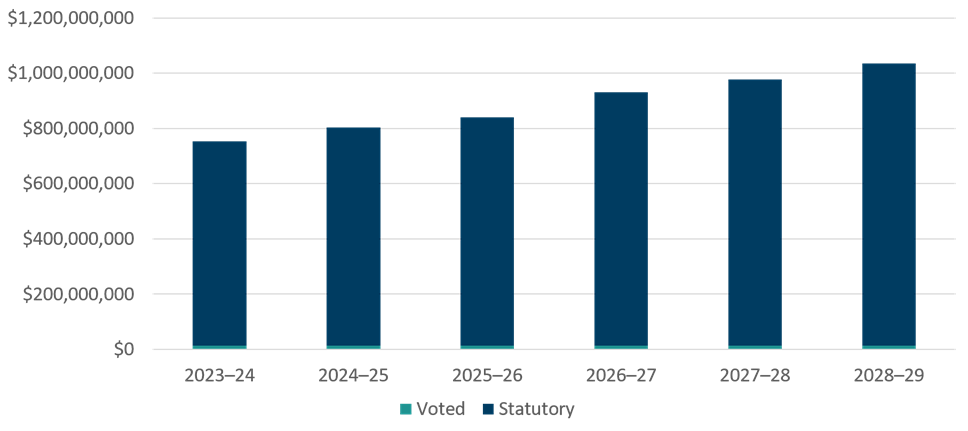
Graph 1 summarizes the department’s approved voted and statutory funding from 2023-24 to 2028-29.
Graph 1: Approved funding (statutory and voted) over a six-year period
Text version of Graph 1
|
Fiscal year |
Statutory |
Voted |
Total |
|
2023–24 |
$739,461,284 |
$13,258,680 |
$752,719,964 |
|
2024–25 |
$789,739,126 |
$14,459,334 |
$804,198,460 |
|
2025–26 |
$827,485,304 |
$13,234,022 |
$840,719,326 |
|
2026–27 |
$916,665,738 |
$13,957,702 |
$930,623,440 |
|
2027–28 |
$962,965,803 |
$13,957,702 |
$976,923,505 |
|
2028–29 |
$1,021,119,683 |
$13,957,702 |
$1,035,077,385 |
Analysis of statutory and voted funding over a six-year period
FJA’s spending increases over the six-year period are largely driven by annual increases in judges’ salaries and pension payments to retired judges and their survivors, as provided for under the Judges Act.
Consult the Public Accounts of Canada for further information on FJA’s departmental voted and statutory expenditures.
Financial statement highlights
This section presents FJA’s Financial statements (Unaudited) for the year ended March 31, 2026.
Table 10 summarizes the expenses and revenues for 2025-26, which net to the cost of operations before government funding and transfers.
Table 10: Condensed Statement of Operations (unaudited) for the year ended March 31, 2026 (dollars)
|
Financial information |
2025–26 actual results |
2025–26 planned results |
Difference (actual results minus planned) |
|
Total expenses |
$842,127,018 |
$849,075,000 |
($6,947,982) |
|
Total revenues |
$23,165,749 |
$19,346,000 |
$3,819,749 |
|
Net cost of operations before government funding and transfers |
$818,961,269 |
$829,729,000 |
($10,767,731) |
Analysis of expenses and revenues for 2025-26
In 2025-26, FJA’s total expenses were lower than planned, mainly due to lower payments under the Judges Act. Revenues were higher than planned, primarily due to higher pension contributions. Overall, these variances resulted in a lower net cost of operations than anticipated.
The 2025-26 planned results information is provided in FJA’s Future-Oriented Statement of Operations and Notes 2025-26.
Table 11 summarizes actual expenses and revenues and shows the net cost of operations before government funding and transfers.
Table 11: Condensed Statement of Operations (unaudited) for 2024-25 and 2025-26 (dollars)
|
Financial information |
2025–26 actual results |
2024–25 actual results |
Difference (2025–26 minus 2024–25) |
|
Total expenses |
$842,127,018 |
$806,028,288 |
$36,098,730 |
|
Total revenues |
$23,165,749 |
$21,697,411 |
$1,468,338 |
|
Net cost of operations before government funding and transfers |
$818,961,269 |
$784,330,877 |
$34,630,392 |
Analysis of differences in expenses and revenues between 2024-25 and 2025-26
FJA’s expenses increased by $36.1 million compared with the previous fiscal year, primarily due to increases in the salaries of federally appointed judges and pension payments to retired judges and their survivors. These increases reflect annual adjustments provided for under the Judges Act.
Table 12 provides a brief snapshot of the amounts the department owes or must spend (liabilities) and its available resources (assets), which helps to indicate its ability to carry out programs and services.
Table 12: Condensed Statement of Financial Position (unaudited) as at March 31, 2026 (dollars)
|
Financial information |
Actual fiscal year (2025–26) |
Previous fiscal year (2024–25) |
Difference (2025–26 minus 2024–25) |
|
Total net liabilities |
$353,346,789 |
$333,638,537 |
$19,708,252 |
|
Total net financial assets |
$7,194,680 |
$6,530,212 |
$664,468 |
|
Departmental net debt |
$346,152,109 |
$327,108,325 |
$19,043,784 |
|
Total non-financial assets |
$377,588 |
$213,941 |
$163,647 |
|
Departmental net financial position |
($345,774,521) |
($326,894,384) |
($18,880,137) |
Analysis of department’s liabilities and assets since last fiscal year
FJA’s liabilities increased by $19.7 million compared with the previous fiscal year, primarily due to actuarial adjustments related to the pension plan for federally appointed judges.
Human resources
This section presents an overview of the department’s actual and planned human resources from 2023-24 to 2028-29.
Table 13 shows a summary in full-time equivalents of human resources for FJA’s core responsibility and for its internal services for the previous three fiscal years.
Table 13: Actual human resources for core responsibility and internal services for the last three years
|
Core responsibility and internal services |
2023–24 actual full-time equivalents |
2024–25 actual full-time equivalents |
2025–26 actual full-time equivalents |
|
Support to federally appointed judges |
59.5 |
57.5 |
56.5 |
|
Subtotal |
59.5 |
57.5 |
56.5 |
|
Internal services |
5.5 |
5.5 |
10.5 |
|
Total |
65 |
63 |
67 |
Analysis of human resources for the last three years
FJA’s total workforce remained relatively stable over the three-year period, with 67 full-time equivalents in 2025-26 compared with 65 in 2023-24. Changes in how positions were classified between the core responsibility and internal services contributed to the shift in FTEs between the two areas.
Table 14 shows the planned full-time equivalents for FJA’s core responsibility and for its internal services for the next three years. Human resources for the current fiscal year are forecast based on year to date.
Table 14: Human resources planning summary for core responsibility and internal services for the next three years
|
Core responsibility and internal services |
2026–27 planned full-time equivalents |
2027–28 planned full-time equivalents |
2028–29 planned full-time equivalents |
|
Support to federally appointed judges |
61 |
61 |
61 |
|
Subtotal |
61 |
61 |
61 |
|
Internal services |
11 |
11 |
11 |
|
Total |
72 |
72 |
72 |
Analysis of human resources for the next three years
Overall, no significant change in total departmental human resources is expected over the next three fiscal years.
Supplementary information tables
The following supplementary information tables are available on FJA’s website:
Federal tax expenditures
The tax system can be used to achieve public policy objectives through the application of special measures such as low tax rates, exemptions, deductions, deferrals and credits. The Department of Finance Canada publishes cost estimates and projections for these measures each year in the Report on Federal Tax Expenditures. This report also provides detailed background information on tax expenditures, including descriptions, objectives, historical information and references to related federal spending programs as well as evaluations and GBA Plus of tax expenditures.
Corporate information
Departmental profile
Appropriate minister: The Honourable Sean Fraser, P.C., M.P.
Institutional head: Marc A. Giroux, Commissioner
Ministerial portfolio: Minister of Justice and Attorney General of Canada and Minister responsible for the Atlantic Canada Opportunities Agency
Enabling instrument: Judges Act (R.S.C., 1985, c. J-1)
Year of incorporation or commencement: 1978
Other: Information about the Canadian Judicial Council, its mandate and programs are found at the Council’s website: https://cjc-ccm.ca/en
Departmental contact information
Mailing address:
Office of the Commissioner for Federal Judicial Affairs Canada
99 Metcalfe Street, 8th floor
Ottawa, Ontario
K1A 1E3
Telephone: 613-995-5140 or 1-877-583-4266 (toll free)
Fax: 613-995-5615
Email: info@cmf-fja.gc.ca
Websites: https://www.fja.gc.ca, https://cjc-ccm.ca/en
Definitions
appropriation (crédit)
Any authority of Parliament to pay money out of the Consolidated Revenue Fund.
budgetary expenditures (dépenses budgétaires)
Operating and capital expenditures; transfer payments to other levels of government, departments or individuals; and payments to Crown corporations.
core responsibility (responsabilité essentielle)
An enduring function or role of a department. The departmental results listed for a core responsibility reflect the outcomes that the department seeks to influence or achieve.
Departmental Plan (plan ministériel)
A report that outlines the anticipated activities and expected performance of an appropriated department over a three-year period. Departmental Plans are usually tabled in Parliament in spring.
departmental priority (priorité)
A plan, project or activity that a department focuses and reports on during a specific planning period. Priorities represent the most important things to be done or those to be addressed first to help achieve the desired departmental results.
departmental result (résultat ministériel)
A high-level outcome related to the core responsibilities of a department.
departmental result indicator (indicateur de résultat ministériel)
A quantitative or qualitative measure that assesses progress toward a departmental result.
departmental results framework (cadre ministériel des résultats)
A framework that connects the department’s core responsibilities to its departmental results and departmental result indicators.
Departmental Results Report (rapport sur les résultats ministériels)
A report outlining a department’s accomplishments against the plans, priorities and expected results set out in the corresponding Departmental Plan.
Full-time equivalent (équivalent temps plein)
Measures the person years in a departmental budget. An employee’s scheduled hours per week divided by the employer’s hours for a full-time workweek calculates a full-time equivalent. For example, an employee who works 20 hours in a 40-hour standard workweek represents a 0.5 full-time equivalent.
Gender-based Analysis Plus (GBA Plus) (analyse comparative entre les sexes plus [ACS Plus])
An analytical tool that helps to understand the ways diverse individuals experience policies, programs and other initiatives. Applying GBA Plus to policies, programs and other initiatives helps to identify the different needs of the people affected, the ways to be more responsive and inclusive, and the methods to anticipate and mitigate potential barriers to accessing or benefitting from the initiative. GBA Plus goes beyond biological (sex) and socio-cultural (gender) differences to consider other factors, such as age, disability, education, ethnicity, economic status, geography (including rurality), language, race, religion, and sexual orientation.
government priorities (priorités pangouvernementales)
For the purpose of the 2025-26 Departmental Results Report, government priorities are the high-level themes outlining the government’s agenda as announced in the 2025 Speech from the Throne.
horizontal initiative (initiative horizontale)
A program, project or other initiative where two or more federal departments receive funding to work collaboratively on a shared outcome usually linked to a government priority, and where the ministers involved agree to designate it as horizontal. Specific reporting requirements apply, including that the lead department must report on combined expenditures and results.
Indigenous business (entreprise autochtones)
Requirements for verifying Indigenous businesses for the purposes of the departmental result report are available through the Indigenous Services Canada Mandatory minimum 5% Indigenous procurement target website.
non‑budgetary expenditures (dépenses non budgétaires)
Net outlays and receipts related to loans, investments and advances, which change the composition of the financial assets of the Government of Canada.
performance (rendement)
What a department did with its resources to achieve its results, how well those results compare to what the department intended to achieve, and how well lessons learned have been identified.
performance indicator (indicateur de rendement)
A qualitative or quantitative measure that assesses progress toward a departmental-level or program-level result, or the expected outputs or outcomes of a program, policy or initiative.
plan (plan)
The articulation of strategic choices, which provides information on how a department intends to achieve its priorities and associated results. Generally, a plan will explain the logic behind the strategies chosen and tend to focus on actions that lead to the expected result.
planned spending (dépenses prévues)
For Departmental Plans and Departmental Results Reports, planned spending refers to the amounts presented in Main Estimates. Departments must determine their planned spending and be able to defend the financial numbers presented in their Departmental Plans and Departmental Results Reports.
program (programme)
An individual, group, or combination of services and activities managed together within a department and focused on a specific set of outputs, outcomes or service levels.
program inventory (répertoire des programmes)
A listing that identifies all the department’s programs and the resources that contribute to delivering on the department’s core responsibilities and achieving its results.
result (résultat)
An outcome or output related to the activities of a department, policy, program or initiative.
statutory expenditures (dépenses législatives)
Spending approved through legislation passed in Parliament, other than appropriation acts. The legislation sets out the purpose and the terms and conditions of the expenditures.
target (cible)
A quantitative or qualitative, measurable goal that a department, program or initiative plans to achieve within a specified time period.
voted expenditures (dépenses votées)
Spending approved annually through an appropriation act passed in Parliament. The vote also outlines the conditions that govern the spending.
- Date modified: